The rakugo training, which began over a year ago, started with three people: Nagase, Takahashi, and Takuya Eguchi (voice of Karashi Nerimaya). Takahashi recalled, It was a year of desperately trying to keep up with rakugo training, something that isn't part of a voice actor's usual daily schedule.
Because rakugo is traditionally passed down orally through live demonstrations, they mentioned hardships unique to actual training, such as not knowing how to write their own scripts for practice.
Regarding practice at home, Nagase revealed, On the days I received training, I would transcribe it (into a script) that same day, read it repeatedly until I memorized it, and then ask for feedback as soon as I had it down. Fukuyama and the others were impressed by her proactive attitude.
Similarly, Takahashi shared her meticulous practice routine: I’m the type of person who can’t move forward without fully understanding, so I’d transcribe the script and research any unfamiliar words as they came up, writing them down in a notebook. I even researched everything about the props used during rakugo—what kind of items they were and how to carry them.
Regarding the practice for the rakugo piece Shibahama, which Shinta performs in Episode 1, Fukuyama said, Even a short version of Shibahama lasts about 30 minutes. As an actor, I’ve never had to memorize lines that long, so I practiced by performing it scene by scene (breaking it down into segments).
He continued, Rakugo isn't something where you can't change a single word, but because I’m so used to not changing the script (as a voice actor), I would freeze up when words I hadn't planned came out. Conversely, I was able to gain feedback on the importance of being "carelessly natural" in a good way.
When asked again about their feelings upon being cast, Nagase, who had empathized with Akane since she first read the original work, stated, I felt like the things said to her by her seniors and masters were also being said to me as a voice actor, so I was incredibly fired up from the start. Takahashi, listening in, voiced her agreement.
Takahashi reflected, Since I work in the field of voice acting, I love stories about aiming for the top. I really wanted to be involved in Akane-banashi, and my heart rate spiked when I heard about the audition. During the audition, I tried out for both Akane and Hikaru with equal passion, but when I was cast as Hikaru, it just felt right.
She continued, When I heard Anna-chan was playing Akane, I felt her heat—like she would really go head-to-head with me—and I thought, "That's a perfect match for my interpretation!" It really fired me up. Takahashi, who also empathized with Hikaru’s words and actions, expressed her passionate hope: I want the voice acting industry to be a place where people like Hikaru exist.
Fukuyama, who was surprised by his own casting, said, Since they entrusted me with the role, I’ll give it my all. While the rakugo element is important, he noted that he personally placed weight on how to play the character as Akane’s father.
At the end of the talk show, Nagase gave a closing message: I think this is a work where both the cast and staff have a high level of enthusiasm, and Mr. Fukuyama is just amazing! I think Episode 1 became something where, seeing his example, I felt I had to do my best too. It’s a work where everyone has a different kind of "heat." Also, the OP! The theme song is a wonderful track by Keisuke Kuwata. The visuals are also packed with the fun and joy of rakugo, so I think it’s a work where you can enjoy rakugo, anime, and music from every angle. I hope you enjoy it. She also mentioned the opening theme song Hitotarashi, performed by Keisuke Kuwata, which has become a hot topic.
Fukuyama also candidly confessed his feelings, saying, I felt like if I lost to Mr. Kuwata’s presence, it would be all over.
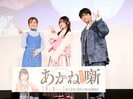
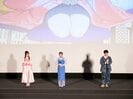
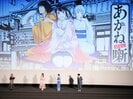
Finally, a photo session was held, and the talk show concluded.
(C)末永裕樹・馬上鷹将/集英社・「あかね噺」製作委員会
Interview, Photography, Text / kato





![[Setlist Included] Mugendai Mewtype Lands in Shinjuku! Report on DAY 2 of the Free Concert Commemorating the TV Anime "BanG Dream! Yume∞Mita" Broadcast, Featuring 11 Songs](https://times-abema.ismcdn.jp/mwimgs/5/f/250w/img_5f88e4ea0c4580db1c1635fc468831861116079.jpg)