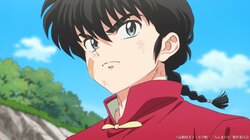
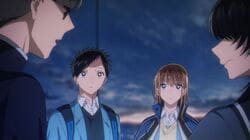
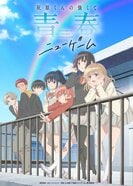
—Tatsuya, Uta, and Reita have been close since middle school, and Natsuki becomes friends with them for the first time through the "Rainbow-Colored Youth Plan." That’s a different dynamic than the one he has with Miori, his original childhood friend.
Uemura: Since she’s a childhood friend, there’s a persistent atmosphere that’s different from the members he met in high school. He can consult Miori about the "Rainbow-Colored Youth Plan," and they stay together as collaborators. I really like the vibe of the conversations they have while heading home on the train—things they can only say there.
—Miori is helping Natsuki because she wants to get closer to Reita, but the change in their relationship as childhood friends is also depicted as part of the drama.
Uemura: I think their bond deepened strictly as friends, but there were expressions where she looked slightly shaken (after seeing a certain scene with Natsuki). While acting with Kanna Nakamura, we both brought out a casual, frank vibe that was different from the other members. We played it with a distance where we could almost talk "roughly" to each other, so it was very comfortable.
—There is a karaoke scene in Episode 3, and I was surprised to hear Natsuki singing a song by an actual artist.
Uemura: Actually, I recorded several songs as Natsuki, and that was one of them. I sang it strictly as part of the story. Natsuki, who hadn't been to karaoke in a long time and only ever went alone, gets invited by Uta to sing together. He starts singing while his heart is racing... The original author, Amamiya-sensei, even told me, "Uemura-san, Natsuki is actually a great singer" (lol).
—That’s a lot of pressure (lol). A very subtle vocal performance is required, right?
Uemura: Exactly (lol). I suggested during the recording that we show a progression: he’s fairly good, but starts out nervous and unable to sing freely, then gradually gains confidence as everyone cheers him on.
—I felt that scene was symbolic of Natsuki, who is facing each event head-on and changing, while initially being quite tense in order to redo his youth.
Uemura: While hoping that Natsuki’s "good but down-to-earth" feel and the fact that he got better through hard work would seep through the singing, I approached the recording very carefully.
![[Photos/Images] "Haibara's Teenage New Game+" Lead Voice Actor Yuto Uemura Discusses Dubbing Episodes: "I was told, 'He’s actually a great singer' (lol)" 2nd](https://times-abema.ismcdn.jp/mwimgs/4/3/724w/img_43a651478d3c06339dc931c268e2d5a9402376.jpg)
Natsuki Haibara doesn't use "cheat" abilities to overpower everyone; instead, he tries to live a new youth through earnest effort and sincere interactions. The fact that the people around him change as a result of his actions is the highlight of "Haibara's Teenage New Game+." Please look forward to the upcoming broadcast.
Interview, Photography, Text / kato
(C)雨宮和希・ホビージャパン/「灰原くんの強くて青春ニューゲーム」製作委員会
List of images for this article





![[Setlist Included] Mugendai Mewtype Lands in Shinjuku! Report on DAY 2 of the Free Concert Commemorating the TV Anime "BanG Dream! Yume∞Mita" Broadcast, Featuring 11 Songs](https://times-abema.ismcdn.jp/mwimgs/5/f/250w/img_5f88e4ea0c4580db1c1635fc468831861116079.jpg)