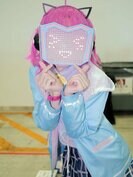
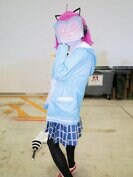
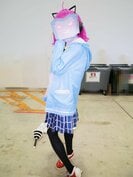
Q. Please tell us about the self-made board's production method and functions (such as controlling facial expression changes).
A.
・Overall rough production method
The main body of the Rina-chan Board was modeled in 3D CAD and output with a 3D printer.
Tape LEDs are used for the facial expressions, and the programs for displaying expressions are stored in a microcontroller. The power source is four dry cell batteries, placed in the bulge of the right ear pad.
Incidentally, the size of the Rina-chan Board was created based on my head size, so if the size is revealed, my head size would be directly revealed—a fatal bug.
This was my first time using 3D CAD, and I created the parts one by one while watching YouTube tutorial videos. I also purchased the 3D printer for this project, which cost about 36,000 yen. Since errors of 0.1mm occur during output, I adjust them each time with filing.
・Vision
I can see forward, and the vision is like constantly squinting. To be able to move around freely while wearing the Rina-chan Board, I created grid-pattern gaps of 0.6mm in the front section. Unless you get quite close, I think it just looks like a plain board.
Quite frequently, people stare intently wondering "Can they see forward?", but when I wave at them from inside, they get surprised, which is amusing to watch. It reminds me of the phrase, "When you gaze into the abyss, the abyss also gazes into you."
・Expression recreation
Tape LEDs are used for the facial expression parts. I cut LEDs at 16-unit intervals and arrange 14 cut strips to create expressions. These LEDs are ultra-thin type, only 4mm wide, so soldering was extraordinarily difficult.
Despite being only 4mm wide, I needed to solder wiring at three points, and soldering wasn't possible without an ultra-fine tip. I remember purchasing a soldering tip specifically for the Rina-chan Board.
Expression switching uses a microcontroller called Arduino nano. I've installed the microcontroller and five switches on the right side of the Rina-chan Board, which I operate each time. One switch is for power, and the remaining four are for operating the LEDs that display expressions.
・Painting
The painting is done with acrylic paint. The filament used in the 3D printer has a slightly water-sensitive nature, but acrylic paint exhibits water resistance when dry. I adopted it for coloring + water resistance reinforcement.
・Five functions implemented in the Rina-chan Board
1.Mode that automatically switches between 6 types of smiling expressions at 1-second intervals This is the main function I use. The expressions photographed for this article are also from this mode. By switching automatically, I'm conscious of having people think "Wow, it's really moving!"
Combining posing and expressions becomes like a gacha, ensuring that multiple shots don't result in similar photos.
2.Mode that automatically switches between 6 types of sad or surprised expressions at 1-second intervals I basically use this when taking scenes of unfortunate situations or scenes with strong comedic elements. When displaying sad expressions, people get worried, so I don't use it normally.
3.Function to change LED brightness
It's possible to change the brightness in 8 levels. Since the appearance of the LEDs changes depending on the brightness of the shooting location, I adjust the brightness according to the environment. During shoots while moving, such as in cosplay parades, I'm adjusting brightness while posing, so it's quite difficult...
Indoors at Tokyo Big Sight, I use the second brightness level from the bottom, and outdoors in the shade, I use maximum light output. And outdoors in direct sunlight, the LED brightness isn't sufficient and nothing appears to show, so shooting itself isn't possible.
4.Mode to fix automatically switching expressions
Expressions can be switched with buttons instead of automatically. I basically use this when there's a specific shot I want with a particular expression.
When expressions change automatically, very rarely the camera's autofocus would act up and lose focus. In those cases, I respond by fixing the expression so it can be photographed slowly.
5.Function called "Rina-chan Beam" that makes the eye parts shine in rainbow colors
This is a gag function that appears in a one-panel manga within the game 'School Idol Festival 2'. It was good that I created the function, but 'School Idol Festival 2' itself ended service in less than a year. Due to the short service period and many new fans, the number of people who don't even know about the Rina-chan Beam has been increasing. Among the implemented functions, this is the only one where I feel "the flow of time is cruel."