TV Anime Digimon Tamers Series Composer Chiaki J. Konaka Interview
Digimon Tamers Is the Only Work Where I Could Seriously Take On Juvenile Fiction
— This year, Digimon Tamers marked its 25th anniversary. Looking back on the series now, what kind of work does it remain in your mind, Konaka?
I wrote the bonus CD drama for the Blu-ray box set that was released in 2018 back in 2017, and that's when the memories of Tamers, which I'd grown a bit distant from, came flooding back vividly. It was also a period when I was personally at the peak of a Tamers boom.
After that came the 20th anniversary, and now the 25th, and I'm truly grateful that this has become a work people celebrate like this. For me, it's the only work where I was able to seriously take on juvenile fiction.
— Please tell us how you came to join Digimon Tamers as series composer at the time.
I think the big factor was handling episode 13 of Digimon Adventure 02, "The Call of Dagomon." I've heard that the original spark actually came during production of the first series, when Hiroyuki Kakudo was considering which Digimon to feature and took notice of Dagomon. Since it was a being reminiscent of Dagon from the Cthulhu Mythos, the idea apparently came up to have me write it.
That episode actually came together as episode 13 of 02, and I believe producer Hiromi Seki watched that process unfold, which I think became one of the reasons I was brought on board for the third installment, Tamers.
On top of that, the series director for Tamers was Yukio Kaizawa. Kaizawa and I had worked together before on Mysterious Magic Fan Fan Pharmacy, part of the Weekly Anime DX! Mii Fa Puu programming block, where I handled series composition and scripts while Kaizawa served as series director. So in the sense that I got to make another year-long series with Kaizawa, I felt it was truly worthwhile. He was, in every sense, a person brimming with talent.
— Tamers has a distinct character within the series, with its setting in the real world and the serious developments that deepen toward the finale. At the time, was there anything you were especially conscious of in making a "Digimon" different from the previous two installments?
I'm working on DIGIMON BEATBREAK right now, but even back then, year-long series with an original story were rare. I wanted to make the most of the storytelling possibilities that could be told across 50-some episodes, while still properly incorporating the toy rollout.
That said, it's not as if the series had nothing to do with the previous two installments. In terms of behind-the-scenes setting, they're actually connected, so to speak. After all, Takato admired Tai and Davis. I was conscious of building a new "Digimon" that existed beyond the previous two, on the premise that they had come before it.
The 'Immature Self and Other' Depicted in Tamers
— Tamers is a work with many distinctive elements, from its setting centered on the real world to the sense of distance in depicting Digimon as 'partners.' How did ideas like these come about in meetings at the time?
Ultimately, I think it was a series about how children who hadn't yet matured would come to face beings different from themselves.
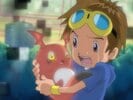
In Adventure, when it came to battles, the children were often in the position of watching over their partner Digimon's fights, weren't they? Of course, that worked fine in its own right, but in Tamers, I wanted to go a bit further into how the human children related to their Digimon and how they fought alongside them. For Takato, Guilmon is a being he conjured up out of imagination, and yet Guilmon gradually becomes someone who won't simply do as Takato wishes—an irreplaceable 'other.' Through that experience, Takato himself grows.
— The three Tamers—Takato, Henry, and Rika—each have very different ways of facing their Digimon. What did you value most at the outset when creating the main characters?
I wanted Takato to be a different type from the protagonists of the previous two series. Rather than a kid who, like Tai or Davis, has that typical protagonist-like strength from the very start, I wanted him to be closer to the children watching—someone with a much more ordinary sensibility. Of course, I didn't intend to make him a crybaby, but looking back, he does cry quite a lot (laughs). Still, he's not a gloomy kid—he's a child whose feelings are very honest and straightforward.
That ordinary boy meets Guilmon, gets swept up in the situation, and gradually comes to think, "I have to go." In other words, he grows through the adventure. To depict that process, it was important not to make the early Takato look too heroic. Looking back now, that approach may have been a bit ambitious.
Guilmon is a Digimon that Takato conjured up in his imagination. Henry, meanwhile, was given Terriermon as his partner, a Digimon Seki was fond of. And for Rika, there was discussion that if we were including a female Tamer, we wanted her partner Digimon to be a strong presence. Given the strength and stoicism built into Renamon's design, Rika herself also needed to be a strong character to match.
So in the beginning, the three of them have quite different ways of relating to their partner Digimon. Takato accepts Guilmon as a being he himself created. Henry has hesitation about making Terriermon fight. Rika, at first, sees Renamon as a symbol of strength. I drew those distinctions in a fairly extreme way, but the plan was for their relationships to gradually change from there, eventually coming together as 'partners.'
— The relationship between Takato and Guilmon is that of 'partners,' yet it also looks like a parent and child, or like a creator and creation. How did you go about developing the relationship between these two?
Having Masako Nozawa perform the role of Guilmon was truly a huge factor. Although Guilmon is a Digimon Takato conjured up in his imagination, he's not just cute, and not just strong. He grows beyond Takato's expectations into a being with a personality all his own. Nozawa's performance was what gave that transformation its persuasive power.
Takato comes to accept the Digimon he imagined as a real, existing 'partner.' What at first felt like his own creation gradually becomes an other who won't simply do as he wishes. That's where Takato's confusion lies, and also his growth. I think the way Takato himself gradually changes through his relationship with Guilmon is part of what makes Tamers' particular kind of interest.
— Rika was initially a character who viewed Digimon in terms of 'strength,' but as the story progresses, her relationship with Renamon changes significantly as well. How did you plan to depict Rika's transformation?
Genki Yoshimura wrote many of Rika's personal episodes. Rika, who was headstrong and initially saw Digimon in terms of 'strength,' gradually changes over the course of the story. Every time I read Yoshimura's scripts, I found something new in that process.
Renamon, too, seems mentally mature at first. But she doesn't understand everything about the Real World or human relationships right from the start. I think part of her growth came from being close to Rika, gradually learning about human emotions and distance. Just as Rika changed through her relationship with Renamon, Renamon also changed by being near Rika. Rather than a relationship where only one side grows one-sidedly, I think the two of them became 'partners' by influencing each other.
Why I Redefined the Digital World as a Network
— While Tamers is a children's anime, it also depicts fairly bold themes, such as the boundary between the real world and the Digital World, networks, and feelings of fear and loss. Were you conscious of balancing how far to take the story in what you delivered to children?
Back in 2001, I don't think the internet was yet a familiar thing for elementary schoolers. It wasn't an era like today, where everyone touches the internet on a daily basis. That said, from the days of Digimon Adventure onward, the term and concept of "Digital World" had already taken root among viewers. I think that was significant.
On the other hand, the Digital World in the previous two series felt more like another world or a parallel world than an actual network. Of course, that was very interesting in its own right, but in Tamers, I wanted to reframe it as something closer to a real-world network—to redefine the Digital World as the internet itself. I think that idea connects back to my experience writing serial experiments lain, a network-horror work, back in 1998.
Of course, I understand there were parts that were difficult for children at the time. But I felt it was fine if they couldn't understand everything on the spot. Something you watched as a kid and thought was "cool" or "amazing" can, when you rewatch it later, turn out to mean something you finally understand: "oh, that's what that meant." I had a feeling that it was enough for that kind of lingering impression to remain within the work.
— The D-Reaper gives a quite different impression from a conventional 'enemy character.' Please tell us why you placed that presence toward the end of the story, and what you were conscious of in depicting it.
I didn't want the final opponent to simply be "an evil Digimon." In Tamers, I saw the Digital World not just as a world of Digimon alone, but as something more like a much broader network, within which Digimon exist as digital lifeforms. Given that, I thought it made sense for there to be a presence even further outside that, one that would pose a threat even to the Digimon themselves.
The D-Reaper isn't an opponent that only Takato and the others fight. The Digimon, and also adults including Mitsuo Yamaki and Janyu, each confront it from their own position. That was important. What happens in that world when, for children, Digimon stop being mere characters and become beings that are truly, actually there? I think I ran through that kind of simulation quite thoroughly.
That said, there was also an image of Digimon that had already been built up through the anime over the previous two series, so suddenly changing that definition might have felt out of place. We approached that carefully on set, explaining it step by step. For Tamers, it was necessary to place the opponent that the Digimon join forces to confront outside of the Digimon themselves.
Next Page