The Drama That Impmon and Beelzemon Led To
— Are there any meetings or exchanges among staff from the production at the time that particularly stand out in your memory? Please tell us if there were any major events as Tamers' direction came together.
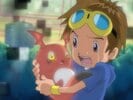
What stands out most in my memory is, without question, Impmon and Beelzemon. At first, Impmon had been proposed as the protagonist's partner Digimon. But personally, I had a strong desire to make this a story about a child meeting a kaiju-like being, something along the lines of Agumon from the first series. That's when Guilmon was proposed anew.
That said, I felt we couldn't just treat the character of Impmon lightly. Precisely because he'd been put forward as a candidate for the protagonist's partner, he needed to be given a major role within the story as well. As a result, I think the flow from Impmon to Beelzemon became an extremely dynamic drama throughout the series.
A great deal of the passion behind this part of the story owes much to Atsushi Maekawa's scripts and Hiroki Shibata's direction. I feel that, thanks to the strength of the staff, the characters' drama deepened to a point I could never have reached on my own.
— Including what happens to Leomon, the Beelzemon storyline is extremely memorable.
What happens to Leomon is an extremely painful development as a story. But it was an event we simply couldn't avoid if we were going to place Beelzemon within a larger drama. What happens after Impmon seeks power and arrives at becoming Beelzemon? I don't think his story would have worked if we hadn't properly depicted that outcome.
At the same time, it was also a major turning point for Takato. Just how dangerous it becomes to hold power when your own emotions run out of control—I wanted children to feel that too. It's precisely because of that event that Takato comes to reexamine his relationship with Guilmon, and I think it's also what gives weight to Beelzemon's subsequent story.
— Another element unique to Tamers is the Card Slash. How did you feel about that idea and its visual expression?
When the idea of fighting using cards came up, how to present it visually as an anime was a major challenge. Simply using a card on its own wouldn't offer much movement as a visual. So the presentation evolved into having the action of slashing the card, which then loads the data.
That said, the Card Slash as it actually appeared on screen far exceeded what I had imagined. That slash bank (reusing footage of a specific scene) was thanks to Kaizawa's direction, which was truly wonderful. There's a real satisfaction to it as action, and that sense unique to Tamers—fighting alongside Digimon by using cards—is packed firmly into that whole sequence of movement. Even watching it now, I think it has a coolness that hasn't aged a bit.
— Rather than everything being decided from the start, was a large part of the story built up during production?
We didn't have every detail of the story mapped out from the very beginning. We were conscious of the broad direction and where things would land, but in practice, a lot of it was worked out as we went along. For example, even the fact that Jeri's partner would become Leomon wasn't decided from the outset.
Together with the other writers, the directors, and Seki as well, we'd discuss things like, "If this happens here, then maybe this kind of development could come next," and build up the story little by little. Rather than moving in a straight line toward a fixed ending, we valued picking up ideas that emerged on set and letting the characters and story move organically.
Of course, it was demanding, but in exchange, I got to encounter developments I never could have thought of on my own. In that sense too, Tamers was a work with a strong sense of having been built by the whole staff together.
(C)本郷あきよし・東映アニメーション
List of images for this article